
Roth contributions and conversions sound like they would refer to the exact same thing – and confusingly, they both accomplish the same purpose: moving money into Roth accounts. The mechanics and consequences are quite distinct, so it’s important to understand the differences.
See the end of this article for an important disclaimer.
Tax Classifications
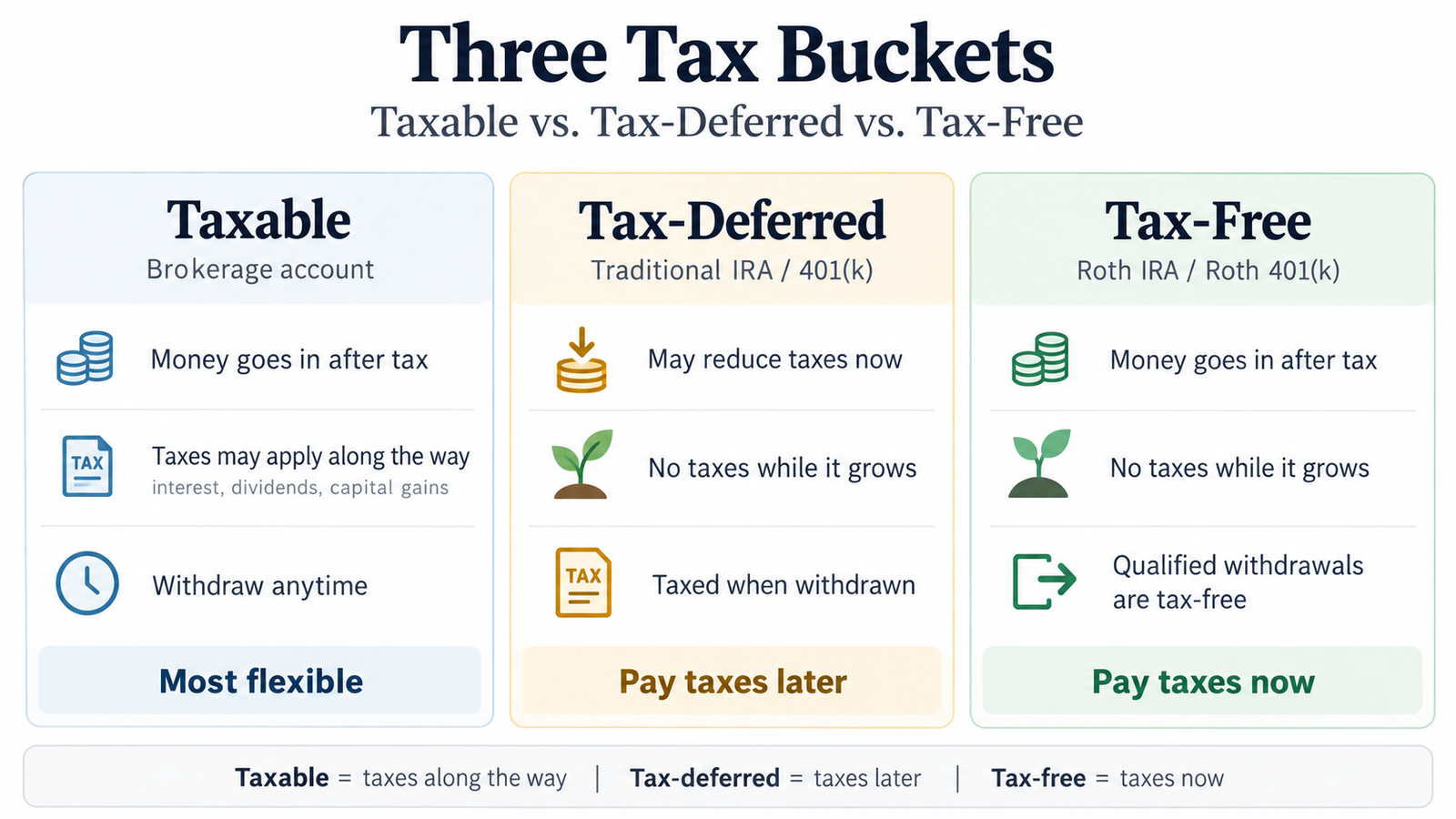
As a reminder, there are three major tax classifications to be aware of.
Taxable: Also called non-qualified or simply “brokerage” funds. In a taxable account, interest, dividends, and capital gains are taxable, but you have a principal that is tracked. This is kind of like a savings account – you can withdraw your money tax-free, but any gain is subject to tax.
Note: Sometimes people refer to a taxable account as “after-tax,” but I avoid using this term because it causes confusion with tax-free accounts. The name “after-tax” comes from the fact that, in order to have money in a taxable account, you had to pay taxes on the principal at some point. For example, funds that you invest in a brokerage account likely came from leftover money from your paycheck, which was taxed.
Tax-Deferred: Also called pre-tax or simply “Traditional” funds. Any withdrawal from a pre-tax account is taxed as ordinary income (similar to income that you make from a job).
Tax-Free: Also called Roth; withdrawals from this account type are the most tax-favorable. Withdrawals from a Roth account are typically tax-free, as long as you are at least 59½ years old and meet the 5-year minimum holding requirements.
Roth Contributions
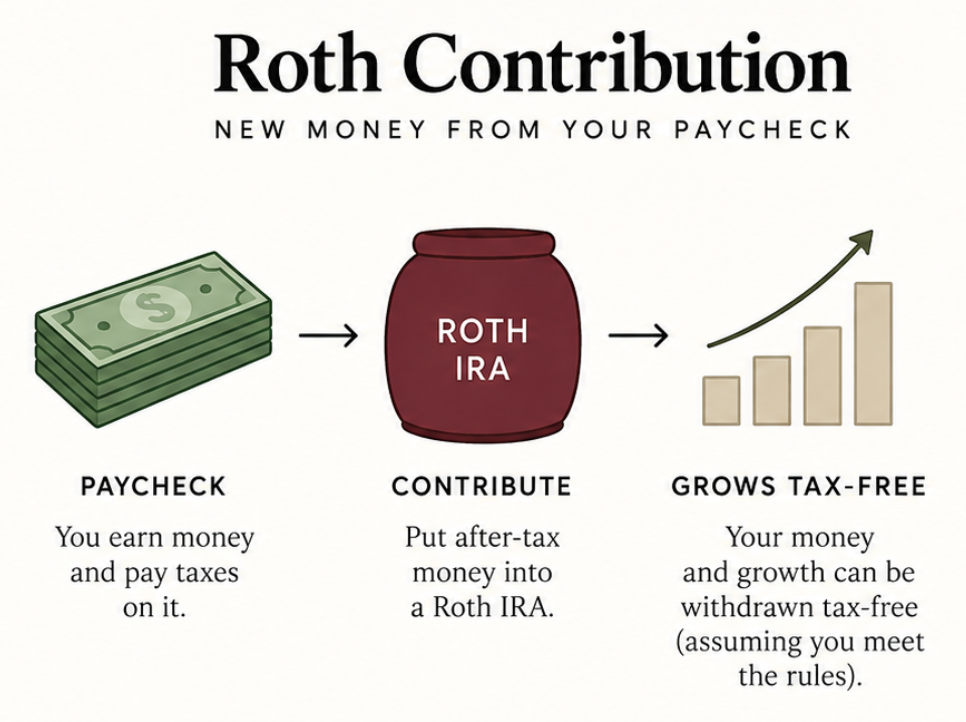
A Roth contribution involves moving money from a taxable account to a tax-free account. The most common example of this is transferring funds from your checking account to your Roth IRA. Roth contributions are not a taxable event.
When you earn money from your job, you generally owe income taxes on those earnings. After you have been paid, you can take some of that money and contribute it to a Roth account. By doing so, you don't get a tax deduction like you would if you contributed it toward a Traditional IRA. Instead, the reward comes later: you can withdraw the money and any interest earned tax-free!
Roth IRAs have limits to how much money you can contribute each year. This limit is $7,500 per person at the time of writing (for tax year 2026), and the limit increases each year with inflation. To contribute to Roth, you have to have earned income for the year as a household (such as income from a job). If one spouse works and the other spouse does not, the working spouse can contribute to Roth for the spouse who does not work.
Roth IRA contributions also have income restrictions, meaning that people who earn too much money may not be eligible to contribute directly.
Roth Conversions
A Roth conversion, on the other hand, involves moving money from a tax-deferred account into a tax-free account. Typically, this is done in an IRA or 401(k) plan. Roth conversions are almost always a taxable event, and they can be a big one.
For example, suppose you make $100,000 per year from your job, and you convert $50,000 from your Traditional IRA to your Roth IRA. Your federal income tax for the year would be similar to if you made $150,000 from your job!
In exchange for paying the taxes now, that $50,000 and its future investment growth can eventually be withdrawn tax-free, provided the withdrawal requirements are satisfied.
Unlike Roth contributions, Roth conversions have no annual dollar limit or income restriction. The IRS is happy to take as much of your tax dollars as you are willing to give them at one time. You could convert five thousand or five million in a single year. Of course, having more income means you push into higher tax brackets, so it’s important to have a holistic, multi-year tax and Roth conversion plan.
Most commonly, Roth conversions are done to minimize the amount of future Required Minimum Distributions (RMDs), or to minimize the tax burden to those who inherit your tax-deferred money. Because of this, you may not reap the benefits of a Roth conversion plan until decades later!
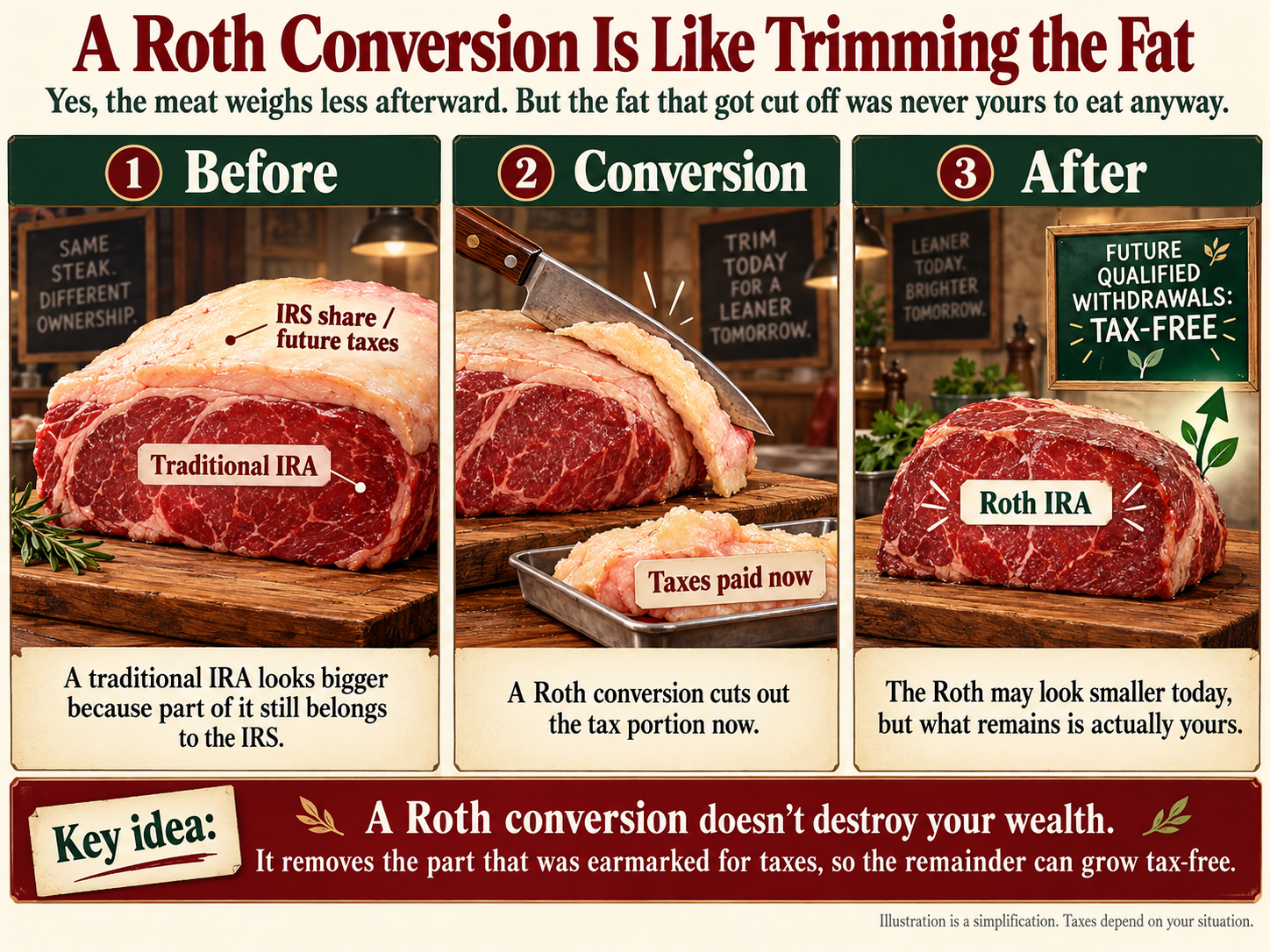
I like to compare Roth conversions to trimming the fat off a nice brisket. Technically, the entire brisket is yours, but some of it isn’t for eating. When you trim the fat off, the brisket weighs less as a result. Similarly, it might not always be good to trim off every single gram of fat – the brisket wouldn’t taste very good without at least some fat! We just want to make sure to keep the right amount.
Why Does the Difference Matter?
The key idea here is that Roth contributions are not a taxable event, and are much easier to justify from a planning perspective. Roth contributions are generally part of an ongoing savings strategy.
Roth conversions, however, are primarily a multi-decade or multi-generational tax planning strategy. Roth conversions can have catastrophic tax consequences if not done correctly, or if done in the wrong amount. These consequences include driving up your Medicare premiums or Social Security taxability, as well as increasing your marginal tax rate.
The objective isn't necessarily to pay less tax today. It's to pay less tax over the course of your lifetime.
And that's ultimately the purpose of Roth conversions: strategically choosing when to pay the IRS, rather than allowing the IRS to make that decision for you.
How To Screw Everything Up
I like to include a few points about what people typically get wrong. To that end, here is a list of things that you can do if you want to make sure to absolutely ruin a tax plan and pay as much in taxes as possible over the course of your lifetime.
For the sake of my compliance department, I’m going to reiterate in bold text that this is a list of things that you probably should not do:
- Disregard the possibility of something bad ever happening to you. Assume you will live well into your nineties.
- Don’t think about what your surviving spouse would pay in taxes as a single taxpayer if something were to happen to you.
- Don’t do Roth conversions while you’re still working. Justify this decision by telling yourself that you’ll be in a lower tax bracket upon retirement.
- Don’t ever do Roth contributions - keep the money in a brokerage account and pay taxes on the gains instead.
- Try to minimize every year’s tax burden, rather than considering your lifetime tax burden.
- Only use Roth conversions to max out your current marginal tax bracket. Don’t ever push into higher tax brackets, regardless of how many years the resulting conversion plan would take.
- Completely ignore RMDs
- Assume that you’ll continue spending the same amount of money forever
- Assume that you will not leave any money to the kids because you will spend it all
Disclosure
This article is intended for educational and informational purposes only and should not be interpreted as individualized financial, investment, legal, or tax advice. Tax laws and regulations are subject to change, and the suitability of Roth contributions and conversions depends on each individual's financial circumstances. Roth conversions may result in significant tax liabilities and other unintended consequences, including increased Medicare premiums and taxation of Social Security benefits. Tax-free Roth distributions are subject to applicable IRS requirements, including age and holding-period rules. Examples are simplified for illustrative purposes and do not represent a guarantee of future tax savings. Consult with a qualified financial advisor and tax professional before implementing any Roth conversion strategy.